


Classic ML Formulations#
We often require classical machine learning approaches for our optimization workflows. GAMSPy currently provides a formulation for decision trees that can be directly embedded in your optimization models. We will roll out additional formulations for other classical machine learning algorithms in the future.
Supported formulations#
RegressionTree#
When a Decision Tree is trained to predict numerical values (rather than class labels), it is referred to as a Regression Tree.
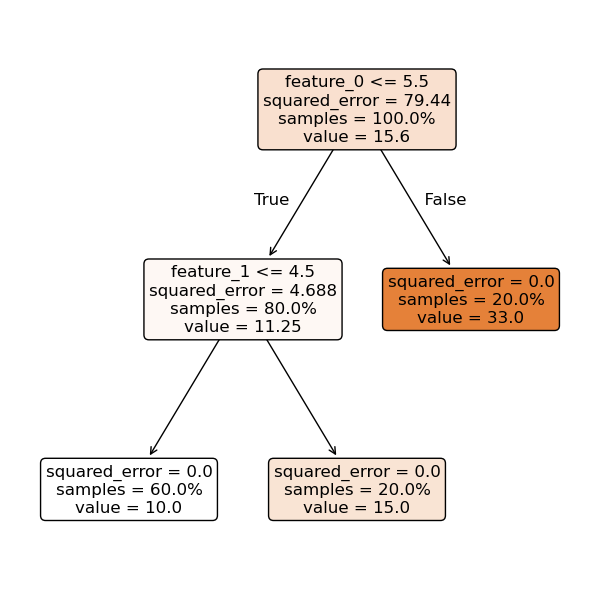
Here is an example where we train a Regression tree and use the formulation to embed in an optimization model.
It should be noted we are using the sklearn.tree.DecisionTreeRegressor. for convenience. You can also provide the information from the trained decision tree as a dictionary.
import gamspy as gp
import numpy as np
from gamspy.math import dim
from sklearn.tree import DecisionTreeRegressor

np.random.seed(42)

X = np.array(
   [
      [2, 3],
      [3, 1],
      [1, 2],
      [5, 6],
      [6, 4],
   ]
)
y = np.array([10, 10, 10, 15, 33])

regressor = DecisionTreeRegressor(random_state=42)
# This is the regressor that you want to include in
# your optimization model
regressor.fit(X, y)

m = gp.Container()
# Formulation requires the regressor
dt_formulation = gp.formulations.RegressionTree(m, regressor)
# Let's create a sample input
m_input = gp.Parameter(m, "input", domain=dim((5, 2)), records=X)

# y_pred = regressor(m_input) and eqns are the equations that
# create this relation
y_pred, eqns = dt_formulation(m_input)

predict_values = gp.Model(
   m,
   "regressionTree",
   equations=eqns,
   problem="MIP",
)
predict_values.solve()
print(y_pred.toDense().flatten())
# [10. 10. 10. 15. 33.]