


Introduction#
Many planning problems play out over time and under uncertainty. You make a decision today, the world then reveals one of many possible outcomes, and tomorrow you decide again with that new information in hand. A reservoir operator releases water this month without knowing next month’s rainfall; a utility commits generation today without knowing tomorrow’s demand. These are multistage stochastic problems, and Stochastic Dual Dynamic Programming (SDDP) is a method for solving them.
This page introduces the ideas behind SDDP. The ClearLake tutorial then puts them to work on a small reservoir model you can run end to end.
A motivating example#
ClearLake is a reservoir managed over four months (jan, feb, mar,
apr). Each month the operator chooses how much water to release, how much
to spill in a controlled flood, and how much to import to avoid running dry.
Spilling and importing are both costly, so the operator would rather do
neither. The catch is the inflow: the rainfall feeding the reservoir each
month is uncertain, and the decision must be made before it is seen.
The goal is a policy (a rule that, for any reservoir level and any realised inflow, tells the operator what to do) that minimises the expected total cost over the season.
Stages, states, and decisions#
SDDP describes such a problem with three ingredients.
Stages are the discrete points in time at which decisions are made, the four months of ClearLake. Stage t happens before stage t+1.
State is the information carried from one stage to the next. For ClearLake
it is the reservoir level: the level you end jan with is the level you
begin feb with. The state is what links the stages together: everything
the future needs to know about the past is summarised in it.
Decisions (or recourse) are the actions taken at each stage (release, spill, import), subject to the physics of the problem (here, water balance) and to bounds (reservoir capacity, maximum release).
Uncertainty: noise and scenarios#
At each stage a random noise is revealed: the inflow. SDDP works with a
finite set of possible noise outcomes per stage, called scenarios, each
with a probability. ClearLake uses three inflow scenarios per month, with
probabilities 0.25, 0.50 and 0.25.
Because a fresh outcome is drawn at every stage, the possible futures fan out into a scenario tree: one outcome branches into three, each of those into three again, and so on.
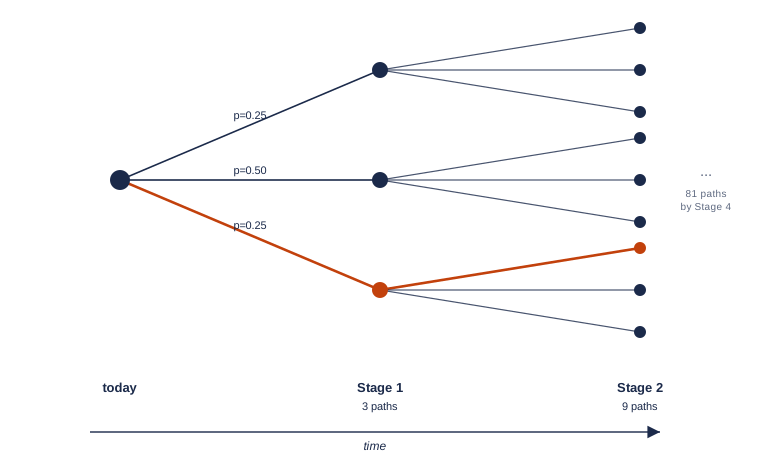
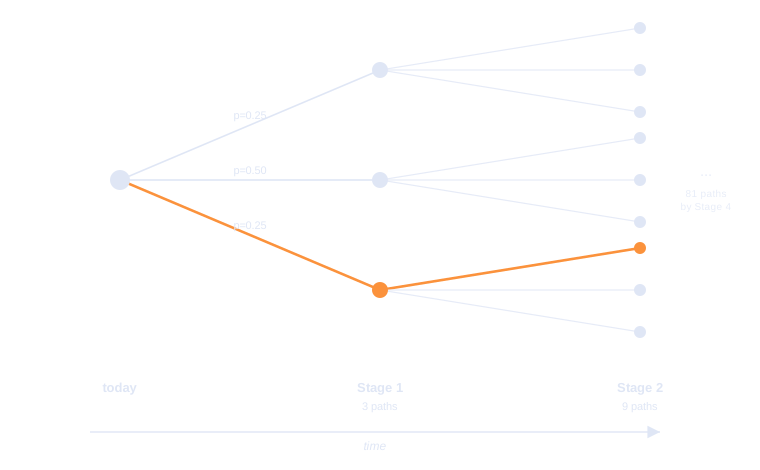
Every stage that reveals a new outcome multiplies the number of paths by S. ClearLake draws a fresh inflow at each of its four stages, so the paths pile up fast: \(3 \to 9 \to 27 \to 81\), giving \(3^4 = 81\) distinct scenarios. In general, S outcomes at each of T stages give \(S^T\) of them, and a year-long weekly model is astronomically larger. Enumerating the whole tree is hopeless, and avoiding that enumeration is exactly what SDDP is for.
Note
The exponent is the number of stages that carry uncertainty. ClearLake’s first stage is itself random, so all four branch (\(S^4\)). If instead the first decision is fixed before any uncertainty is revealed, as in a classic two-stage program (which has \(S\) scenarios, not \(S^2\)), the tree branches one fewer time, \(S^{T-1}\).
The cost-to-go function#
The central object is the cost-to-go (or value) function \(Q_t(x)\): the expected cost of operating optimally from stage t onward, given that you arrive at stage t with state \(x\). It satisfies a recursion: at each stage, given the incoming state, you pay this stage’s cost and inherit the expected cost-to-go of wherever you land:
where \(u_t\) is the stage decision, \(\xi_t\) the realised noise, and \(x_t\) the outgoing state.
If we knew \(Q_{t+1}\) exactly, every stage would be a simple one-step optimisation. We don’t: computing it exactly is the very tree explosion we just saw. SDDP’s idea is to approximate the cost-to-go instead.
How SDDP approximates the cost-to-go#
For the convex (linear) problems SDDP targets, each \(Q_{t+1}\) is a convex function, and a convex function is the upper envelope of its tangent planes. SDDP builds the cost-to-go from below, one cut (a supporting hyperplane) at a time, by alternating two passes:
a forward pass samples a path through the scenario tree and rolls the state forward, producing trial states to examine; and
a backward pass solves the stage problems at those trial states and uses their linear-programming duals to add a new cut that tightens the approximation.
Each iteration also yields a lower bound on the optimal expected cost. As cuts accumulate the approximation sharpens and the bound rises; when it stops improving, the policy has converged. The exact algebra of the cuts, the bound, and the sampling is left to the topic pages; the recursion above is all you need to read the tutorial.
The workflow in GAMSPy#
The whole method lives behind the SDDP
class. You write your stage problem as ordinary GAMSPy variables and equations,
register the state and the noise, and then:
build()injects the SDDP machinery into your model,train()runs the forward/backward iterations to learn the cuts,policy()queries the trained policy at a single situation, andsimulate()evaluates it on fresh Monte Carlo paths.
See also
The ClearLake tutorial builds, trains, and queries a complete SDDP model in a few dozen lines.