


The SDDP Workflow#
Using SDDP in GAMSPy means writing your stage problem as an ordinary GAMSPy
model and letting an SDDP instance drive it.
This page walks the lifecycle and the one pattern that is specific to SDDP: the
active-stage gate. The ClearLake tutorial shows every
step running end to end.
The lifecycle#
A model goes through the same sequence every time:
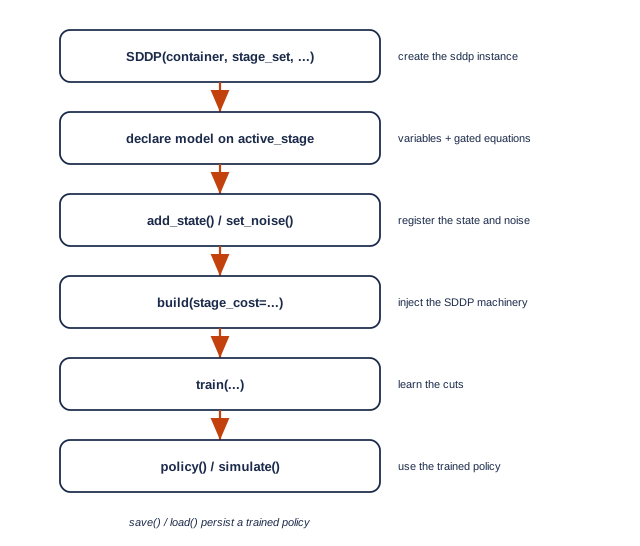
You create the instance first (it owns the active-stage set the equations need),
declare your variables and equations, register the state and the noise, and call
build(). From there train() learns the policy, and policy() /
simulate() put it to work, with save() / load() to keep a trained
policy between sessions.
Creating the instance#
sddp = SDDP(container, stage_set=t, n_trials=5, seed=42)
The constructor takes:
container: thegp.Containerholding your symbols.stage_set: the set of stages; its length is the number of stages.time_set: the full time domain, only needed when each stage spans several time steps (see below). Defaults tostage_set.n_trials: the number of trial trajectories explored per iteration.seed: the forward-pass sampler seed, for reproducible runs.verbose: print one convergence row per iteration during training.
The active-stage gating pattern#
SDDP solves your model one stage at a time. To make that possible, the
instance owns a dynamic singleton set, exposed as sddp.active_stage, that
always contains exactly the stage currently being solved. You reference it in a
.where[...] clause on every stage-indexed equation:
stage = sddp.active_stage

balance[t].where[stage[t]] = (
    L[t] - L[t.lag(1, "circular")] + R[t] + F[t] - Z[t] == precip
)
During each per-stage solve the engine flips active_stage to the current
stage, so only that stage’s equations are active. You never assign to it
yourself; you only read it in the gate.
Note
active_stage holds one stage at a time, never “all stages” or “all
but the first”. Gating every stage-indexed equation on it is what lets the
same algebra serve every stage in turn.
Stages and a finer time grid#
By default each stage is a single time step, so stage_set is all SDDP needs.
Some models carry several time steps inside one stage, for example hourly
detail within a weekly stage. In that case pass the full time domain as
time_set; its length must be a whole multiple of the number of stages, and
the state is linked across the last time step of each stage.
Building the model#
sddp.build(stage_cost=cost)
build() injects the SDDP machinery (the future-cost variable, the cut
constraints, and the batch-solve scaffolding) into your container. Two things
to know:
stage_costis the variable holding the per-stage operational cost only, without any future-cost term. SDDP adds the future cost itself. At least one of your equations must definestage_cost, orbuild()raises.equationsdefaults to every equation in the container; pass an explicit list to include only some.
build() is a one-shot step: add_state() and set_noise() must come
before it, and cannot be called afterwards.
Training and using the policy#
With the model built, train() runs the iterations and returns a result
object carrying the lower bound and convergence history; policy() answers a
single “what should I do here?” query, and simulate() evaluates the policy
over many Monte Carlo paths. A trained instance can be written to a .sddp
file with save() and reloaded with SDDP.load() for inference without
retraining.
See also
The ClearLake tutorial runs the whole lifecycle on a concrete model.